

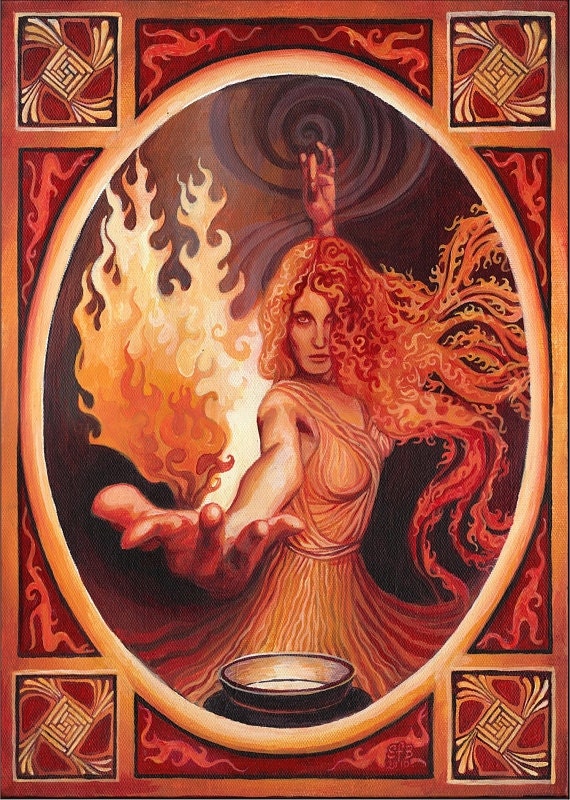
Brighid was the patron of poets and bards, as well as healers and magicians. She also represents herbalism, childbirth and midwifery, hearth fire, and smithcraft. She was a Goddess of Fire and a Warrior. She was especially honored when it came to matters of prophecy and divination. She was honored with a sacred flame maintained by a 19 priestesses, and her sanctuary at Kildare, Ireland, later became the home of the Christian variant of Brighid, St. Brigid of Kildare. Kildare is also the location of one of several sacred wells in the Celtic regions. There are wells all over Ireland sacred to Brighid. Water is associated with healing and wisdom.
Some facts and correspondences:
Name: Brighid/ Brigit/ Bríd/ Brigid / Bride
Race: Tuatha Dé Danann
Properties: Healing, Fertility, Smithcraft, Poetry, Midwifery/Childbirth, Herbalism, Hearth Fire, Inspiration
Lesser Properties: Agriculture
Father: The Dagda
Husband: Bres Mac Elatha
Consort: Turenn son of Oghma
Sons: Brian, Iuchar & Iucharba (Gods of Poetry) by Turenn
Grandson: Ecne (God of Knowledge)
Associated Deities: Danu
Festival: Imbolc (1st February)
Season: Spring
Element: Fire
In many Pagan traditions today, Brighid is celebrated with crafts that honor her role as the protector of the hearth. You can make a Brighid corn doll; as well as a Bride’s Bed for her to sleep in. Perhaps the best known decoration is the Brighid’s Cross whose arms represent the place where a crossroads comes together, the space between light and dark. You can find multiple sites on how to make the Brighid’s Cross..even you tube video’s so I won’t go into that here. To make a Bride’s Bed:
* You’ll need a small box, or basket. Line it with a towel or small blanket. Add or make a small pillow and place in the basket as well. Then top with another warm blanket, just like your own bed. Place the bed by your hearth fire. If you’ve made a Brighid doll, place her in the bed before you go to sleep at night. If you don’t have a Brighid doll and don’t wish to make one, you can use a broom or besom to represent Brighid instead. The broom is an old symbol of female power and the fertility that Brighid represents. If you want to bring fertility and abundance into your home this year, make sure Brighid doesn’t get lonely in her bed. Place a Priapic wand (acorn wand) in there with her to represent the god of your tradition. Remember — fertility doesn’t just mean sexuality. It also applies for financial gain and other abundance. Once Brighid is in her bed, you can gather around the hearth fire with your family, and welcome your guest with the traditional greeting, spoken three times:
Brighid is come, Brighid is welcome!
Leave candles burning beside Brighid throughout the night – place them in a dish of sand or dirt for safety considerations. If you need inspiration in a matter, or wish to work some divinatory magic, stay up throughout the night and meditate, asking Brighid for guidance. I put my candles in my cauldron or right in my fireplace after the hearth fire dies down.
One of my favorite tales about the goddess Brighid involves two lepers who appeared at her sacred well at Kildare and asked to be healed. She told them that they were to bathe each other until the skin healed. After the first one was healed, he felt only revulsion for the other and would not touch him to bathe him. Angered, Brigid caused his leprosy to return. Then she gently placed her mantle (cloak) around the other leper who was immediately healed. This also goes along with her mantle or cloak of green…as she comes in the Springtime, her cloak awakens the Earth and it greens and the flowers start to bloom. How wonderful!
To have Brighid represented at your altar for Imbolc, you can of course have a statue of her, print a picture off the internet, a book of poetry or your own poem you’ve written, healing herbs, silver coins, and lots of candles. A cauldron of water could represent her sacred wells. If you aren’t familiar with Brighid I hope this post gives you reason to learn about her and to place her high on your list of favorite goddesses. She will not disappoint you!
Love and Blessings, Autumn
*Some of this information comes from About.com and Goddess Gift and my own BOS.


