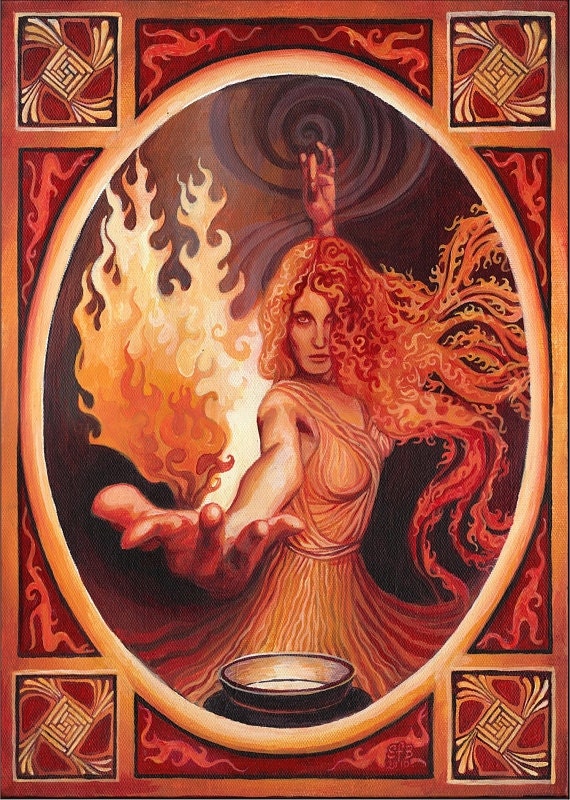
Imbolc, pronounced IM-bolhk, is the Gaelic festival marking the beginning of spring, during which great feasts were held. Imbolc is usually held on February 1st, or halfway between the winter solstice and spring equinox. The day was believed to begin and end at the sunset, so the celebrations would start on the night before. Imbolc is the celebration of the heart and home, and a ceremony of the elongating days the early signs of spring. Celebrations often involved hearthfires, special foods, divination or watching for omens, candles or a bonfire if the weather permitted. Fire and purification were an important part of the festival.
Other names: Candlemas, Oimealg, Imbolg, Brigantia, Lupercus, Disting, Lupercalia
Date: February 2, or when the sun is at 15 degrees Aquarius
Meaning of the word: Imbolc means “in milk”
Primary Focus: New growth, end of winter, rituals of purification, offerings to deity, candle rituals
Age of holiday: Unknown
Astrological Sign: 15 degrees Aquarius
Planetary ruler: Saturn, Uranus
Color Associations: Brown, Lavender, Light green, Orange, Pale yellow, Pink, Red, Silver, White
Herbs: Angelica, Basil, Bay, Benzoin, Blackberry, Celandine, Chamomile, Clover, Coltsfoot, Dill, Heather, Myrrh, Rosemary, Rowan, Yellow Flowers, Willow
Stones: Amethysts, Bloodstone, Garnet, Onyx, Ruby, Turquoise
Incense: Apricot, Basil, Bay, Benzoin, Carnation, Cinnamon, Daffodils, Evergreen, Frankincense, Heather, Iris, Jasmine, Musk, Myrrh, Neroli, Olive, Primrose, Rosemary, Snowdrop, Sweet Pea, Tansy Trees, Vanilla, Violet Willow, Wisteria
Animals and Beasts: Bears, Burrowing Animals, Deer, Dragon, Eagles, Ewes, Firebird, Groundhog, Lamb, Owl, Phoenix, Raven, Robin, Sheep, Snakes, Stags, Other creatures waking from hibernation
Symbols: Acorns, Besom, Birchwood, Brigid’s Cross, Brigid’s Wheel, Burrowing Animals, Candles, Corn Doll, Daffodils, Evergreens, Ewes, Fire, Grain/Seeds, Lanterns, Marigolds, Milk, Plum Blossoms, Snowflakes, Sun Symbols, White Flowers
Food: Blackberry Tea, Bread, Cakes, Cheese, Curries, Dairy, Fish, Herbal Tea, Honey cake, Muffins,Pancakes, Poppyseed Bread/Cake, Poultry, Pumpkin, Raisins, Rice Pudding, Scones, Sesame Seeds, Spiced Wine, Spicy Foods, Sunflower Seeds, Waffles, White Meat, Yogurt, Dishes containing Onions, Peppers, and/or Garlic
Magickal Ideas for Your Ritual:
-Add a circle of white candles to the altar setup, each one representing a goal you would like to achieve in the coming year. Empower, then light during ritual.
-Banish winter by burning paper snowflakes.
-Empower ice to banish negativity. As the ice melts, so the negativity will drain away. Pour water off your property.
-Plant seeds to be cared for indoors, or buy an indoor plant and make friends.
-Bless your pet and give him/her a sage amulet for his or her collar, or place in a protected area on the cage (for smaller animals).
-Purify the house with a house blessing ritual incorporate into the sabbat, or do one separately.
-In ritual, offer milk to the gods, then pour on the ground, or leave in a bowl for the animals.
-Do a vision/meditation on the wolf totem.
-Imbolc is a fire festival falling the the fixed astrological air sign of Aquarius. The magick that you do during this time period will have long-lasting consequences. Uranus and Saturn bring the ability to make sudden changes, research for rewards, and learn how to interact with authority figures.
-Imbolc is a good time to do any magickal workings that include: cleansing, purification, renewal, initiation, candle work, house/temple blessings, storytelling, stone collecting, awakening rituals, bonfires, fertility magick, consecration (especially of agricultural tools), healing magick, home and hearth blessings, new beginnings, spells for good luck, and weather divination
Imbolc Invocation*
Coronet of candles, each flame a golden jewel
Saturn Lord withdraws his cloak
yet retains his rule.
Lambs bleat seasons greetings
spring’s essence on their breath
the sun pays homage to sky in Aquarius.
The Lord and Lady dance the waltz
within the magick round
to banish all that isn’t pure
and prime the sacred ground.
The Cailleach swirls her tempest skirts
to raise the season’s storms
that which lies within her wake
will surely be reborn.
The time has come for tilling
to arrange for harvest’s gain
the right amount of seed and skill
of wind and sacred rain
are needed to perform the task
of planning for my future
I conjure such by Breid’s bright word
and nothing will refute her.
The cat that leaps is not
the can that lands upon the star
I conjure things that others think
appear from thinnest air
yet superimposition reigns
my choice a pattern set.
(Insert what you wish for here)
My power grows, the light ignites
desires manifest!
Imbolc Incense*
Time: Best mixed the week prior to February 2.
Herbs:
½ cup acacia gum
½ cup hyssop
¼ cup lavender
Oils:
7 drops apple blossom oil
5 drops bergamot oil
Chant:
New Beginnings. New Goals. New life.
Keep in mind, all of my posts are based on my opinions that I have gathered from my research. You may disagree or have something to add. Please do so kindly in the comments.
Blessed be, brothers and sisters.
*Credited to “Solitary Witch” by Silver RavenWolf
Brighid comes back into the world at Imbolc, a holy day full of rich traditions such as making Brighid’s wheels, making a bed for Brighid, laying out cloth and items for her to bless, making Brideog dolls and some make their vows and state their dedications for the year. Then there are those who, due to age or illness (and a thousand other reasons), cannot say yes to another year of living.
Imbolc Vows
In the days of keening, laments would be heard all year where people gathered to mourn loved ones. While many take their vows at this time of year and say yes to Brighid and yes to another year of living, there are those whose time isn’t to say yes as they have begun their journey onto the next world.
My grandmother was one of those who couldn’t say yes to another year of living at Imbolc and so took that journey with Brighid who birthed her into her next life. As with tradition, there was a wake with her body returned to the house in the coffin while neighbours came to visit. Keening was long gone by this time and the song for those days was the clinking of teacups on saucers and the rattling of rosary beads. I was a little taken aback when neighbours came over and lovingly touched her face and stroked her hair, for I had never seen a dead body before and my Grandmother looked different due to the makeup the Mortuary staff had used. The wake is an old tradition where the body is kept at home for three days after death – so that the person can adjust to being dead and know it’s time for them to leave this realm of the living and move on to what awaits them.
What is Keening
Anne Schilling who has studied keening for many years defines keening the verb, ‘to keen’, as the act of wailing and lamenting and yet it can also be described as a noun ‘the keen’, meaning the text or the song used when lamenting. Traditional keening is a ritualistic practice of vocally mourning the dead. While there are schools of thought exploring both theories, (Schilling, 2013) suggests that both are correct due to the evolution and the variations of keening over the years.
I’d love to play you some keening tracks to illustrate what keening is but none exist, plus keening is traditionally done in the presence of a dead body. By the time we had tools to record, Keening was already seen as a backwards Pagan tradition and, women couldn’t be persuaded to give an example of a keening song, as to do it outside of it’s proper ritual before a body laid out was a great superstition (McCoy 2009).
The keen itself drew upon traditional motifs, themes and vocalisations with a characteristic falling inflection of the voice with a three part structure comprised of a salutation, verse and then the cry. Some of those inflections you would recognise from modern singers such as Sinéad O’Connor or Dolores O’Riordan. Yet the keening couldn’t break out too early or the ‘devil’s dogs’ were alerted and the soul could lose it’s way (McCoy 2009).
Keening was always a woman’s tradition and the role of keening, like today’s funeral, was to take our grief through ritual and a rite of passage of sorts allowing us to go on with our lives even though we still held our personal grief.
The roots of keening lie within the Pagan tradition and the purpose of the keen is as (Collins 2014) explains to traversing the parallel worlds of this world and the next and as the keener used her voice guided the dead person’s soul from this world to that of the spirits and so the sound of the keen connects this world and the next. It is the very essence of a female shamanic tradition which Collins explains: “It is possible to suggest that keening women entered state of liminality through use of what ordinarily would be publicly unacceptable words, sounds – such as howling, screeching and wailing – appearance and dramatic actions, occupying a peripheral position, a state of betwixt and between, inhabiting both this world and the next. This was very different to women’s regular behaviour presented in public which did not allow women the opportunity to behave, dress, act out or publically criticize their world. Bean chaointe* gave the impression of being out of this world, and through inclusion of the congregation during the third part of the keen, constructed a space in which change would happen. Between worlds, outside of custom, convention or the law, and neither of this world nor the next, the bean chaointe, bringing the community from actions of their keen were the means through which transformation occured, bringing the community from a state of intense grief and disharmony to a post-liminal state, a place of acceptance and stability.” (Collins 2014, pg. 3)
*Bean chaointe – keening woman
Brighid
It is the Goddess Brighid who brought keening to the world. In the Battle of Moytura, Brighid appears as the wife of Bres of the Formarians, the mythical Irish invaders and enemies of the people of the Goddess Danu. The position Brighid plays as married to a Formarian see’s her acting as an intermediary between the two opposing sides who are fighting for control over Ireland. Her son, Ruadan, was given help by the people of the Goddess Danu, his maternal kin, who taught him how to make weapons. Yet he acts on behalf of his paternal side, the Formarians and wounds the sacred Smith (blacksmith) of the People of the Goddess Danu. He only wounds the smith who has enough strength left to retaliate and kills Ruadan. Brighid then begins to mourn her son and it is said that through her grief was the first time crying or wailing were ever heard in Ireland (Condren 1989, pg. 61).
The Disappearance of Keening
In the mid-nineteenth century, in post famine Ireland and with the emergence of a new middle class, keening became an embarrassment in a society that was modelling itself on Victorian values and beliefs. The Catholic Church viewed keening as barbaric and uncivilised and went out of their way to banish the practise. They viewed the keening woman as taking on the role of the priest and viewed it as a Pagan practise as it contained no reference to Christ and the Christian afterlife (Collins 2014).
As a woman, artist and priestess, my mind paints a picture of the woman keener as stepping into the role of the death priestess, a tradition of Brighid as the midwife of birth and death, accompanying the soul onto the otherworld. For me, this is a tradition which taps into the lineage of my foremothers, a shamanic tradition of women’s mysteries which can be traced going back to the Paleolithic.
The American Wake
An Irish storyteller describes that when people left for America they were grieved for, a term called “cumha” which he describes as a grieving for the living (Porter, 2013). For those taking that journey out of desperation, choice or by force of law, it’s not hard to imagine the grief for those leaving didn’t even know that they would survive the journey, they didn’t know if they would ever be able to return and i they did return it is highly likely that many friends and their parents would be dead.
My Own Keening
I have lived in the Appalachians for seven years. I return home as much as I can and regularly keep in touch with family. Social media has allowed me to keep in touch with family I wouldn’t normally be able to have conversations with. I often think of the ancestors of the people in this area and can feel that sadness that they must have lived the rest of their life with – not getting back home to familiar land. As much as I get to go home and, plan to move back at some point, sometimes a particular cold temperature or a strong enough wind suddenly transports me home and I’m surprised not to see a wide mountain view when I open my eyes. The positioning of a hill on the horizon here in Western North Carolina see’s my mind superimposing a familiar scene from home on top of that scene. While it’s not something I talk about I wonder if others longing for home did the same thing?
Maybe part of this superimposing of familiar places isn’t just your own longing for home but in the words of John O’Donohoe: “Perhaps your place loves having you there. It misses you when you are away and in its secret way rejoices when you return. Could it be possible that a landscape might have a deep friendship with you? That it could sense your presence and feel the care you extend towards it? Perhaps your favorite place feels proud of you.” (O’Donohoe 2003, pg.24).
I find that song and these rituals of missing a place a keening of sorts, there is no death but a constant melody of grief or longing. It is an emotion that can always be heard within the melodies of much Celtic music. I hear the same longing between the words of stories, from women who attend workshops and yearn for a time they’ve never lived and a place they’ve never visited.
Keening Ceremonies Today
In her study of keening, Michelle Collins attended several modern keening events. She notes that the contemporary keen is now found outside of the traditional funeral setting. Keening ceremonies are infrequent events where groups come together and keen. At such ceremonies, participants are not keening any one individual’s death as each person keens their own personal grief.
My Keening Invitation
While I have always been interested in keening since an Irish cousin told me there were keening women in the family, it has only become real since a friend – who has described her death as ‘a body which is deathing and a soul ready to be born into her new role in the next world’ – invited me to facilitate a keening ceremony at her wake. As she works through the last things she wishes to do in this world, she is breaking apart our society’s taboo about dying! We have sung together with our tribe, explored communicating from the otherside, explored ancient Old Europe rituals of death and made Goddess figurines in the pottery studio. She has talked to children about her process of dying, painted murals and held our hands in this process.
Keening in a Time of Crisis
Brighid created keening and we live in an age which desperately needs to engage with our grief. We are on a threshold between what is and the new world which we are creating. That new world is being built by millions of grassroots programs which are already flourishing. Keening is still a healthy ritual to mourn our dead and, mourn all our personal griefs and, it can invite us to move through our grief and allow us to put our full focus on the work we do now. It can be the catalyst to move us out of a shocked and stunned apathy.
It was the Wise Woman throughout countless generations who was called in a time of crisis. Today we find ourselves in the middle of a crisis which can affect every living system on the planet. Both the Wise Woman and keening come out of an ancient female tradition that is much needed in today’s world.
Right now on this planet women all over the world are holding a collective grief for what is happening. As a woman I can only reflect on my own personal experience through the unique ways women relate to the world. Brighid gave us keening and I use keening as a way for groups of women to unleash, to vocalise and to embody their grief with purpose. The purpose is not to stay with the grief, but to move beyond it into asking for wisdom in what needs to be done and stating what each individual commits to doing. Joanna Macy (Macy and Brown 2014) offers a powerful example within her program of “The Work that Reconnects”. All of this work invites us to dig down to the roots and be nourished by an ancient spirituality, which has fed countless generations of women and holds the torch for remembering we did once live in balance and partnership with each other and honored life in all forms and the mother of all.
Resources
Collins, Michelle. 2014. ‘Divine Madness’ and Collective Grief: Ritualized Sounds and the Potential for Transformation.
(Accessed online: http://www.inter-disciplinary.net/probing-the-boundaries/wp-content/uploads/2014/08/collinstsb4paper.pdf)
Condren, M. 1989. The Serpent and the Goddess. Women, Religion, and Power in Celtic Ireland. Harper and Row, USA.
McCoy, Narelle, Phyllis. 2009. Madwoman, Banshee, Shaman: Gender, changing performance contexts and the Irish wake ritual. Contained in: Mackinlay, E. and Bartleet, B. and Barney, K, (Eds), Musical Islands, Place and Research. Cambridge Scholars Press, UK. Pgs. 207-220.
Macy, J. and Brown, M. 2014. Coming Back to Life. New Society Publishers, Canada.
O’Donohoe, John. 2003. Divine Beauty: the Invisible Embrace. Bantam Books, London.
Porter, G. 2013. Grief for the Living: Appropriating the Irish lament for songs of emigration and exile. Humanities Research. Vol XIV. No. 2. Pgs. 15-25.
Schilling, Anne. The Search for Irish Keening in the 21st Century. Voice and Speech Review. Pgs 148-154. (Published online 2013 – accessed 02/01/2017: http://www.tandfonline.com/doi/abs/10.1080/23268263.2011.10739534?journalCode=rvsr20).